
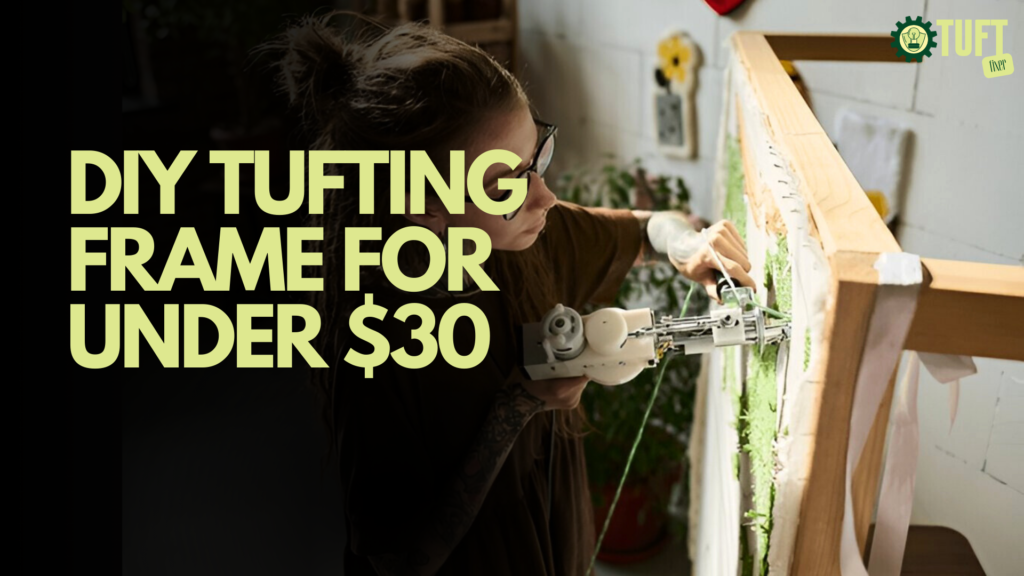
How to Build a DIY Tufting Frame (Save $100+)
Table of Contents
You bought the best tufting gun. You bought the correct cloth. You bought the yarn. Then you looked at the price of tufting frames online and realized they cost $150 or more for a few pieces of wood.
Do not buy a pre-made frame.
Building your own DIY tufting frame is the rite of passage for every tufter. It is cheaper, stronger, and allows you to build it to the exact size you need. Plus, you can build a massive 5-foot frame for less than $30 in lumber.
In this guide, I will show you exactly how to build a rock-solid tufting frame in an afternoon, even if you have never built anything before.
The Shopping List (What You Need)

Go to your local hardware store (Home Depot, Lowes, or local lumber yard). You don’t need fancy wood; standard construction pine is perfect.
The Wood:
-
3 pieces of 2×4 Lumber (8 feet long): This will build the main square and the legs.
-
2 pieces of 1×2 Furring Strips (optional): For yarn guidance (we’ll get to this later).
The Hardware:
-
Box of 2.5-inch Wood Screws: To hold the frame together.
-
4 “L-Brackets” (Corner Braces): To reinforce the corners so it doesn’t wobble.
-
2 “C-Clamps”: To clamp the frame to your table.
The “Secret Weapon”: Carpet Tack Strips This is the most important part. You need Carpet Tack Strips (also called Gripper Rods).
-
These are thin wooden strips with hundreds of tiny sharp nails pointing up.
-
Why: This is what holds your Monk’s cloth tight. You do not want to use staples! Tack strips let you restretch the cloth instantly.
Step 1: Decide Your Size (The "Goldilocks" Rule)
How big should you make it?
- Too Small (2×2 feet): Too Small (2×2 feet): You will regret making your DIY tufting frame this small
- Too Big (6×6 feet): It will be heavy, hard to store, and the cloth will sag in the middle.
- Just Right: 30 inches x 30 inches (approx. 75cm x 75cm).
- This is perfect for creating standard 2ft x 2ft rugs, which is the most common size for beginners.
Cut List for a 30×30 Frame:
- Cut 2 pieces of 2×4 at 30 inches (Top and Bottom).
- Cut 2 pieces of 2×4 at 33 inches (Sides). Note: The sides are longer to account for the overlap.
(Tip: Most hardware stores will cut the wood for you for free if you ask nicely!)
Step 2: Assemble the Box
- Lay the two 33-inch pieces vertically on the floor.
- Place the two 30-inch pieces between them at the top and bottom.
- Screw it together: Drive two screws into each corner. This creates the main structure of your DIY tufting frame.
- Pro Tip: Drill a small “pilot hole” first so the wood doesn’t split.
- Add the L-Brackets: Screw a metal L-bracket into each of the 4 corners. This stops the frame from twisting when you lean on it.
Step 3: Adding the Legs (The "Kickstand")
Take your leftover 2×4 wood. Cut two pieces about 20 inches long.
Screw them to the bottom of the frame, sticking out backwards like feet.
Add a diagonal brace (a piece of wood going from the foot to the side of the frame) to make a triangle shape. This prevents the frame from tipping over when you push the gun against it.
Step 4: The Tack Strips (Watch Your Fingers!)
This is the dangerous part. Tack strips are incredibly sharp.
Nail the strips to the front face of your frame.
Crucial Direction:
Make sure the nails point OUTWARDS. This holds the fabric tight. If your frame is loose, the cloth will bounce and rip. Read our guide on why tufting cloth tears to understand why tension is so important.
Bottom strip nails point DOWN.
Left strip nails point LEFT.
Right strip nails point RIGHT.
This creates a “claw” effect. When you stretch the cloth over the nails, they hook into the fabric and pull it tight in all directions.
Step 5: Yarn Feeding (The Screw Eye Hack)
The number one frustration for beginners is the yarn getting tangled.
Buy small metal “Screw Eyes” (loops).
Screw one into the top center of your frame.
Thread your yarn through this loop. It keeps the yarn flow smooth. If the yarn catches on the wood, it creates tension and is a common reason for tufting yarn falling out.
This lifts the yarn up and keeps it away from the moving gears of the gun. It’s a $0.50 upgrade that saves hours of frustration.
Summary: Clamp It Down!
our frame is built. It looks rough, but it works perfectly.
Before you start tufting, use your C-Clamps to lock the DIY tufting frame the table. If you don’t clamp it, the frame will dance across the room while you are trying to work.
Total Cost: ~$25 Time: 1 Hour Satisfaction: 100%
Once your frame is built and your first rug is tufted, check out our guide on how to finish and back your rug to turn that piece of carpet into a professional product.