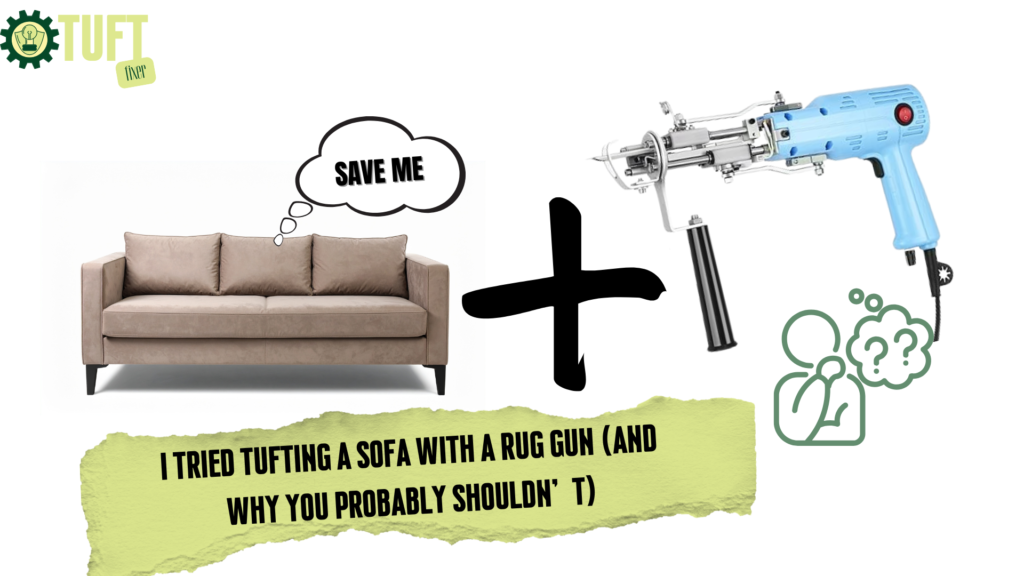
Let me start with a confession: I once thought I was a genius for trying to “speed-tuft” a thrifted velvet armchair using my AK-I cut pile gun. I figured, “It’s just fabric and foam, right?” Wrong. Ten minutes in, I had a hole the size of a golf ball in the velvet and a gun that was jammed with shredded foam.
If you’re reading this because you’re staring at a sofa and a tufting gun, wondering if you can combine them—take a breath. It’s possible, but it is a total nightmare if you don’t change your strategy. Here is what I learned the hard way (so you don’t have to).
1. The “Fabric Shredder” Effect
The biggest shock for me was how differently upholstery fabric behaves compared to primary tufting cloth. Tufting cloth is designed to let a needle pass through; velvet and linen are designed to resist it.
When that needle hits at 40 stitches per second, it doesn’t “weave”—it slices.
- The Mistake: Using a Cut Pile gun directly on the sofa. The little scissors inside the gun don’t just cut the yarn; they cut your sofa’s soul.
- The Real Fix: If you must tuft directly onto the piece, switch to Loop Pile. It’s much more forgiving. But honestly? The real pro move is tufting your panels on a standard frame first, then stretching them over the sofa like a regular upholstery job. It feels like “cheating,” but it’s the only way to get that crisp look without a disaster.
2. Why Your Gun Keeps “Jumping” (The Tension Problem)
You know that satisfying thump-thump-thump when you’re tufting a tight frame? You won’t get that on a sofa. The foam is squishy. When you push the gun in, the foam pushes back, and the gun just bounces off the surface.
I spent two hours trying to figure out why my lines looked like a drunk person drew them.
- What worked for me: I call it the “Double-Handed Lean.” You have to put your body weight into the gun to compress the foam before you hit the trigger.
- The Hack: If your fabric is too loose, try spraying a bit of temporary adhesive on a scrap of tufting cloth and slapping it on the back of the sofa area. It gives the fabric just enough “grip” to keep the needle from wandering.
3. The “Popped Button” Panic
Nothing ruins a Saturday like a tufting button snapping off while you’re sitting on the couch. Most people think they need to strip the whole sofa to fix it.
You don’t. But you do need to stop using standard sewing thread. I used heavy-duty polyester thread on my first repair and it snapped within three days.
- The Secret: Get some waxed upholstery twine. It feels like dental floss on steroids.
- The Tool: You’ll need a 12-inch needle. You literally have to stab it all the way through the back of the sofa, hook the twine, and pull it back. It’s terrifying the first time you do it, but it’s the only way to get that deep “dimple” look that stays put.
4. Is the Foam “Sinking”?
If you tufted your sofa and it looked great for a month but now looks “sad” and saggy, I have bad news: you probably used cheap craft foam. Tufting puts a massive amount of constant pressure on the foam.
If it’s already sagging, I’ve found that you can sometimes “save” it by stuffing a bit of extra poly-fill into the tuft hole from the back using a chopstick. It’s a bit of a “Band-Aid” fix, but it’ll get you through another year.
The Bottom Line
Tufting furniture is addictive, but it’s a completely different beast than rug making. Don’t expect your first project to be perfect. Expect to rip some fabric, lose a few buttons, and swear at your foam.
My advice? Practice on a small footstool before you touch your main sofa. Your living room will thank you.